Lake Bunyonyi | Amazing spot before and after Gorilla trekking
November 11, 2023Bird Watching Checklist of Volcanoes National Park
November 26, 2023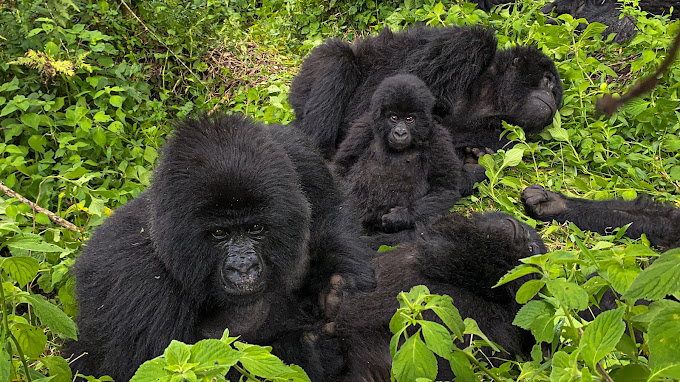
The Great Apes also known as Hominidae are tailless primates comprising of gorilla, chimpanzee, orangutan and humans. Opposed to other primates, apes do not have tails. Apes brains are much more developed than those of other primates. Gorillas and chimpanzees are found in Africa and spend most of their time on the ground, while orangutans are found in Asia and spend most of their time in the trees. 3 of the great apes (Gorillas, chimpanzee and orangutans) are listed in as Endangered Species of Wild Fauna and Flora. Its only humans that are not endangered since they can be found anywhere on the planet with increasing numbers every day.
- GORILLAS
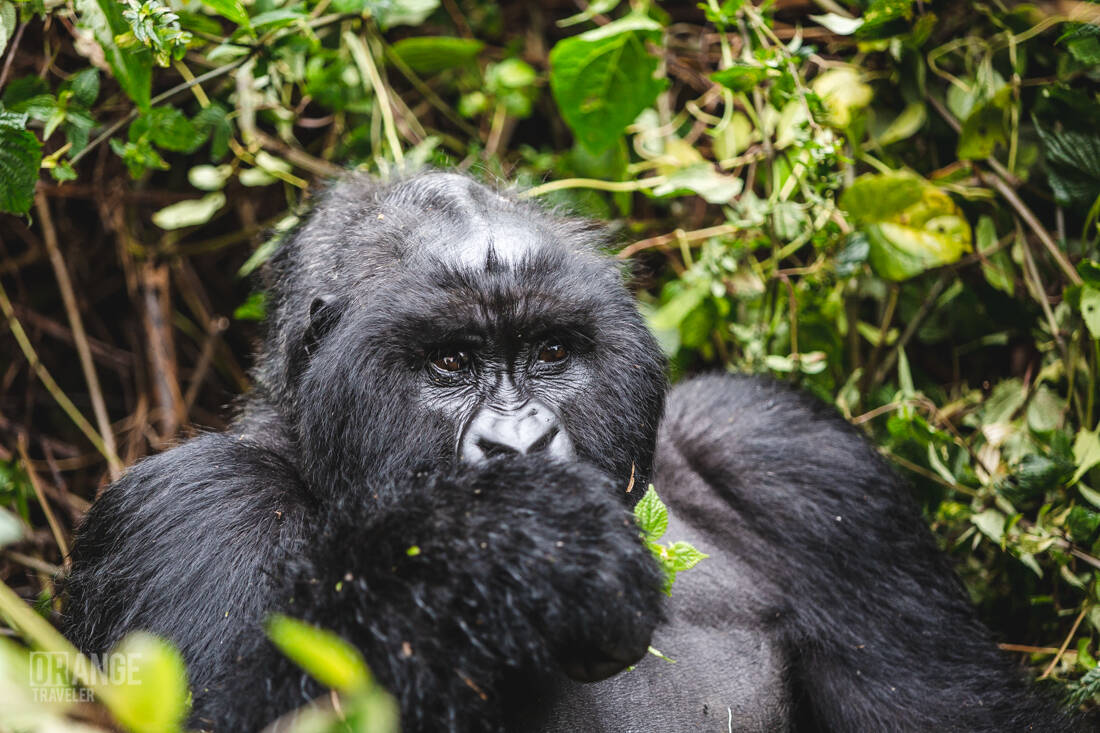
Ben the bold headed silverback gorilla
The adult male gorilla stands about six feet tall and weighs more than 350 pounds. Much of this weight is in their mighty chest and massive arms. Far from being ferocious beasts, gorillas are actually mild mannered vegetarians who keep to themselves. There are three types of gorilla: the eastern lowland, the western lowland and the mountain, all are endangered. There are about 10,000 eastern lowland gorillas in eastern Zaire. In western Africa, there remain approximately 100,000 western lowland gorillas. Some 1,000 miles to the east in Zaire, Uganda and Rwanda lives the last surviving mountain gorillas. Only 1,000 mountain gorillas remain in the wild of the Virunga massive and Bwindi impenetrable forest. They have been forced to retreat steadily farther and farther up the mountain sides as the lower slopes are occupied by humans and turned over for the production of agriculture. Most gorillas live in groups of five to thirty individuals usually with a single “silverback” male who acts as the leader. Groups are very cohesive and generally peaceable.
Gorillas are closely related to humans, sharing around 98% of our DNA. Family groups have a harem structure, meaning groups are typically made up of 1 male, multiple females, and their offspring. However, mountain gorillas are known to support more than one adult male per group. Gorillas are herbivorous, eating mostly vegetation and some fruits. Mountain gorillas specifically do not eat many fruits, subsisting mostly on the low calorie vegetation and bamboo native to their montane habitat.
2. CHIMPANZEES
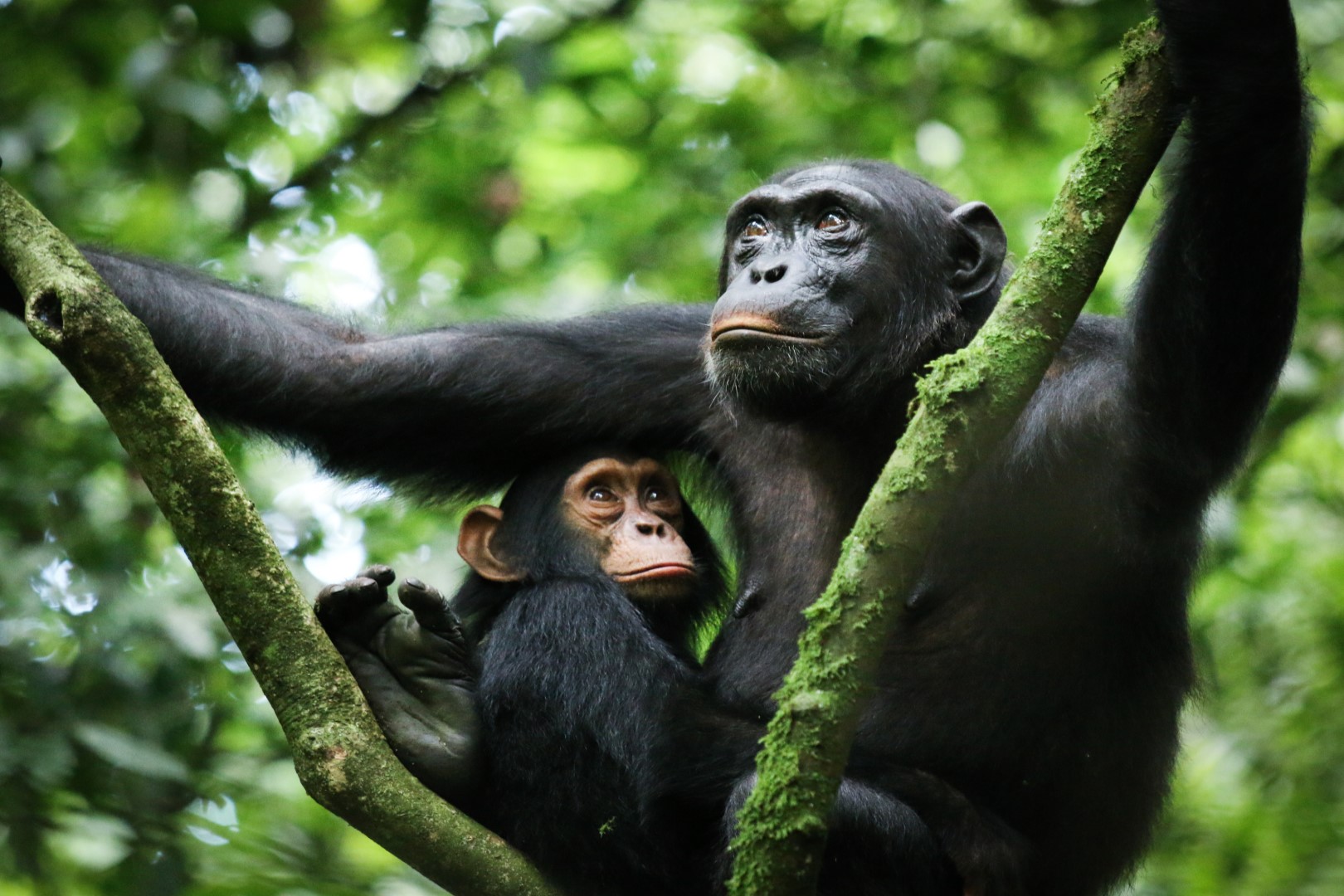
Chimpanzee and her baby in Uganda’s Kibale forest
Even more closely related to humans are chimpanzees, with roughly 99% of their DNA in common with ours. There is only 1 chimpanzee species, the common chimpanzee, but they are divided into 4 subspecies. The subspecies are divided by location, and they can be found across central Africa, to the north, east, and west of the Congo river.
Chimpanzees are highly social and have a fission fusion social structure, which means they form very large groups that can divide into smaller bands for traveling and foraging, especially when food availability is low. They are patriarchal, with very structured groups. While chimpanzees are known to occasionally consume meat and insects (they even hunt down smaller mammals, including monkeys), their diet mainly consists of fruit and they are considered omnivorous frugivores.
They are known for using tools such as sticks, stems and blades of grass to flush ants and termites from mounds. Baby chimpanzees, like other apes, have a strong bond to their mother and are dependent on her for many years after birth.
The population of chimpanzees has dwindled to an estimate of less than 250,000, with significant populations found in fewer than five countries. This decline is primarily due to the dramatic destruction of African forests in the last 15 years. In addition, adult chimpanzees are killed and sold in local meat markets, and mothers are killed in order to capture their babies and put them up for sale. The few traumatized infants which manage to survive are marketed as pets, or sold to dealers for use in entertainment or medical research.
3. ORANGUTANS

An orangutan sits in the forest canopy of Indonesia Borneo.
Orangutans are the only non-human great ape native to Asia and the only ape not found in Africa. Their name translates to “person of the forest”, and they share about 97% DNA with people.
Males are approximately twice the size of females, weighing up to 220 pounds and reaching a height of five feet. With great flexibility, they climb trees with ease using their hands and feet almost interchangeably. A large percentage of their daylight hours are spent searching for and consuming food. Each night a new nest for sleeping is constructed from boughs. The nest is built 40 to 60 feet up in a tree. Their diet is mainly fruit, in particular the fruit of the Durian tree.
Orangutans are split into 3 species: Bornean (which has 3 subspecies), Sumatran, and Tapanui (which was more recently discovered). All three species are found only in Indonesia, with the Bornean orangutan located on the island of Borneo, and the Sumatran and Tapanui on the island of Sumatra. Orangutans have the simplest social structure of all great apes, called a noyau structure. They are semi-solitary, meeting only for mating and occasionally foraging in the same trees. Infants stay with their mothers for approximately eight years, after which they become solitary. Like chimpanzees, orangutans are considered frugivores, however, they do not hunt and consume meat like chimps.
Pre-historically their numbers were probably in the hundreds of thousands and their range extended from southern China through southeast Asia. Today their total numbers range from 20,000-27,000. They are endangered primarily because their habitat continues to be altered or destroyed by logging, agriculture, fires and the practice of killing a mother to secure an infant or juvenile for the live animal trade. Many times baby orangutans become pets or are used in the entertainment industry. Usually 6 to 8 die for every one that survives!
4. BONOBOS
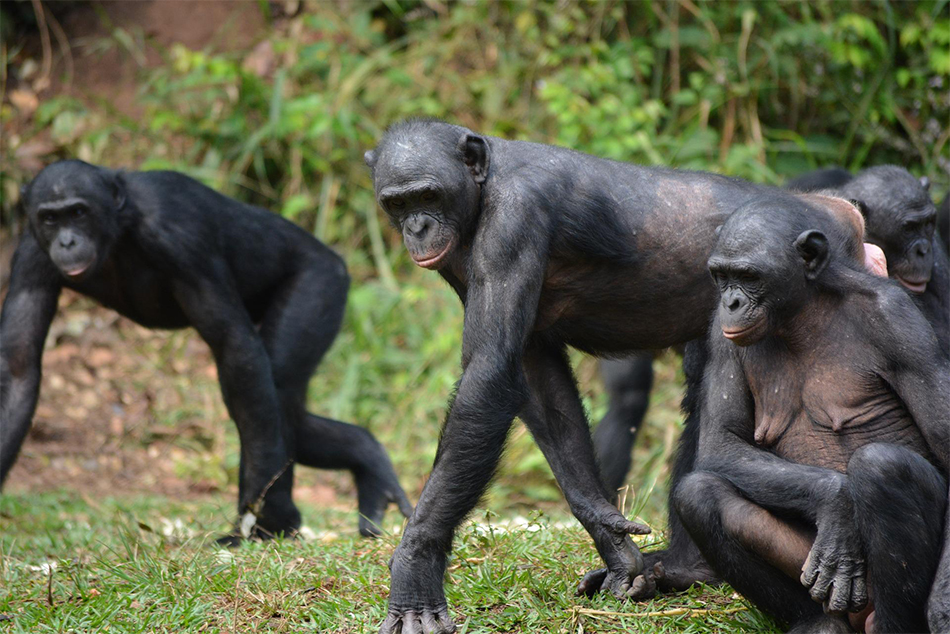
Bonobo at Loya ya Bonobo in Democratic Republic of Congo
Previously known as the pygmy chimpanzee, bonobos, and humans share about 99% of their DNA. Common chimpanzees and bonobos look very similar, but bonobos are a distinct species and can be identified by their slender build and light-colored lips. They are found only in the Democratic Republic of Congo, south of the Congo river, and have zero subspecies. While bonobos and chimpanzees share a fission-fusion social structure, bonobo societies are matriarchal, meaning the females lead the group. They are considered omnivorous frugivores, with fruit making up about 57% of their diet. Like chimpanzees, they will occasionally consume meat, including small primates, but do not actively hunt them.
5. HUMANS
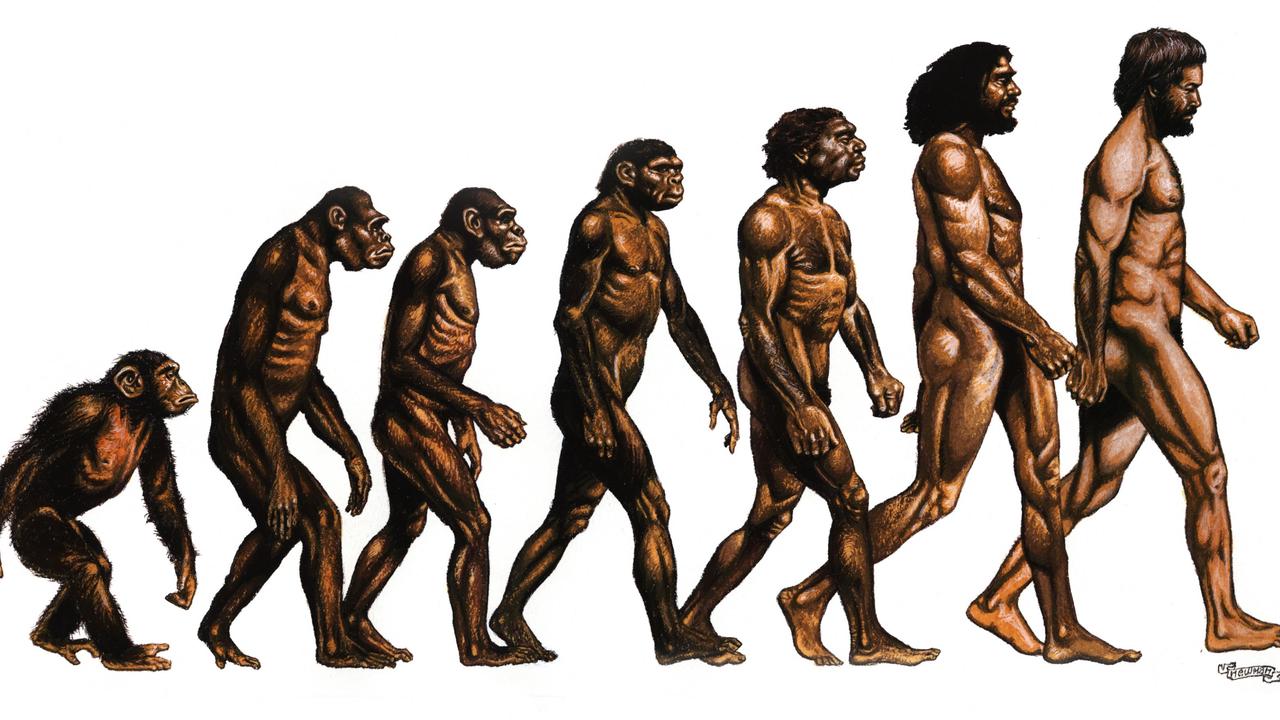
Human evolution as apes
Humans as known as Homo sapiens, a name translating to “wise man”, is currently the only surviving human species. There are 0 subspecies of humans. We diverged from Homo erectus, the most closely related human species, about 500,000 years ago, and from the other great apes between 5 and 7 million years ago. Although humans originated on the continent of Africa, we have done some major dispersing and can now be found worldwide.
We are highly social primates and show an extraordinary variety of complex social structures and mating systems, ranging from monogamy to polyandry. Unlike the other great apes, humans are true omnivores, with skulls built to process many different types of food matter. We also have evolved to walk bipedally, allowing for better support for our heavy brains and freeing up our hands for tool usage.